
The IE University Admissions Test is an English-language online assessment for undergraduate applicants. It measures verbal, numerical and logical reasoning; selected School of Science and Technology programmes add a mathematics assessment. IE also publishes accepted alternatives such as SAT, ACT and, for Law routes, LNAT. The applicable option must be confirmed for the chosen programme.
The decision behind the test
This guide answers the route question before discussing preparation. IE describes undergraduate admissions as holistic: academic records, background, extracurricular involvement, English ability, test results and the online assessment are considered together. The IE test can normally be taken only once. Applicants should therefore verify whether they will use IE's test or an accepted external result before starting the assessment section of the application.
Current official position
IE states that its test is conducted only in English and focuses on reasoning rather than content recall. The current page lists numerical reasoning, verbal reasoning, deductive logical thinking and learning efficiency. The mathematics assessment is limited to specified Science and Technology programmes. IE also states that no outside preparation centre is authorized or officially affiliated with the university.
Our recommended next steps
Choose the programme first. Read its admissions page and the central test page together. Decide whether an external standardized result is valid and preferable for your route. If using the IE test, complete the required part of the application and pay the application fee before opening the test. Reserve an uninterrupted window, use a compatible computer and complete the official examples.
Mistakes we recommend avoiding
Do not confuse the undergraduate IE Admissions Test with the ieGAT used in postgraduate admissions. They serve different applicants and official sources must be matched to the degree level. Do not treat third-party preparation as university-endorsed, and do not assume a published minimum for an alternative test is an admission guarantee.
What happens after the test?
After the application and test, applicants complete an online assessment with written and video responses. Some applicants may also be invited to a personal interview. The Admissions Committee then issues a written decision. If admitted, official enrolment and document requirements still need to be completed.
Draw the route before choosing preparation material
Place the selected bachelor programme at the top of a one-page flowchart. Under it, list the IE test and every external alternative the current degree page accepts, such as SAT, ACT or LNAT where applicable. Mark whether the Science and Technology mathematics hour belongs to the programme. This immediately separates undergraduate choices from the postgraduate ieGAT and prevents an irrelevant format from shaping the study plan.
For each valid route, compare the result already available, remaining preparation, reporting date and application timing. Once a route is chosen, record the next stages—online assessment, possible interview and committee decision—so the reasoning test stays in proportion to the whole file. Recheck the portal before opening IE’s one-attempt assessment. The official examples are the appropriate place to learn the interface; opening the live test should happen only after the application, equipment and uninterrupted time are ready.
Select the route before opening an assessment
Start with the programme page, not a generic test description. IE may accept its own admissions test or an external result such as SAT or ACT, while Law routes can involve LNAT. The available alternative and any programme condition must be checked for the exact degree. Selected School of Science and Technology programmes add a 60-minute Mathematics Assessment to IE’s route.
Compare options using evidence you already have and the application calendar. A valid external result may reduce new test preparation, while IE’s online assessment may fit an applicant who has not taken another standardised test. Consider reporting time, validity and programme rules. Do not begin IE’s one-attempt test merely to see what it looks like; use the official examples for familiarisation.
The undergraduate IE Admissions Test should not be confused with the postgraduate ieGAT. Match every source to the degree level. IE also states that outside preparation centres are not authorised or officially affiliated, so commercial material should never be presented as university-endorsed.
See the test in the complete selection process
IE describes admissions as holistic. Academic records, background, extracurricular involvement, English proficiency, the test and online assessment all contribute. Some candidates may also have a personal interview. This means the test supplies evidence of reasoning; it is neither the whole application nor a published guarantee of admission.
Finish accurate application fields and pay the required fee before expecting access to the test section. Maintain school records and prepare the personal stages while training reasoning. A narrowly optimised test plan can be counterproductive if it leaves an inconsistent motivation statement or missing document.
What the core assessment asks
Numerical reasoning requires judgments based on supplied data. Verbal reasoning applies evidence discipline to written information. Deductive logical thinking uses graphic patterns, and learning efficiency tests ordered recall after a short presentation. The assessment is in English and focuses on reasoning rather than broad subject recall.
Current published timings are short: 12 minutes each for numerical and verbal work, six for deductive logic and five for learning efficiency. The total process is longer because of instructions and examples, usually about 70 to 90 minutes; IE advises reserving up to two hours. There is no scheduled break.
Selected science and technology candidates face the additional mathematics section, which assesses stated subject knowledge including algebra, linear algebra, calculus, geometry, probability and statistics. Confirm this requirement before choosing materials or reserving the session window.
Prepare transferable procedures
Use the official examples to learn task demands. For numerical statements, label units and bases before deciding. For verbal items, point to the exact evidence and resist adding outside facts. For patterns, name the transformation. For learning efficiency, apply a consistent scan and encoding order.
Track both accuracy and pace. IE says speed and correctness are considered and that wrong answers can affect the result, but it does not publish a universal pass mark. Avoid promised score conversions. Review unsupported errors, time traps and unseen items, then adjust the method that created them.
At least one rehearsal should reproduce the uninterrupted sequence and technical setting. Use the same computer, camera, microphone and connection intended for the remotely proctored attempt. Reserve the full window, close background software and follow current rules on the calculator and workspace.
Avoid the route mistakes with the highest cost
The first is mixing undergraduate and postgraduate assessments. The second is overlooking the additional mathematics hour for a relevant programme. The third is assuming an outside provider has inside knowledge or official status. The fourth is opening the one-attempt test before the room and technology are ready.
Another costly assumption is that an external score automatically satisfies every programme. Read the current degree page and admissions portal. If two official pages appear inconsistent, ask undergraduate admissions and keep the answer. The current instruction for your application controls the route.
What happens next after the test?
IE sends the result directly to the Admissions Committee; applicants do not select or upload a conventional score report. The next stage is the online assessment with short written and video responses. Some applicants may be invited to interview, depending on what the committee needs for the file.
Review your submitted application before those stages. Prepare specific, truthful examples about learning, collaboration and motivation rather than memorised slogans. Continue monitoring the portal and email, and respond to requests by the stated deadline.
The committee communicates the final decision in writing. If admitted, complete acceptance, payment, final-transcript and enrolment requirements. Conditional offers remain dependent on their stated evidence. International applicants may then need recognition, visa and relocation arrangements. Those later actions should follow the actual offer; directly after the test, complete the online assessment and keep the application accurate.
Relevant preparation
Preparation for IE University
Choose the option that fits your next step. Scope and current pricing are shown on the offer page.
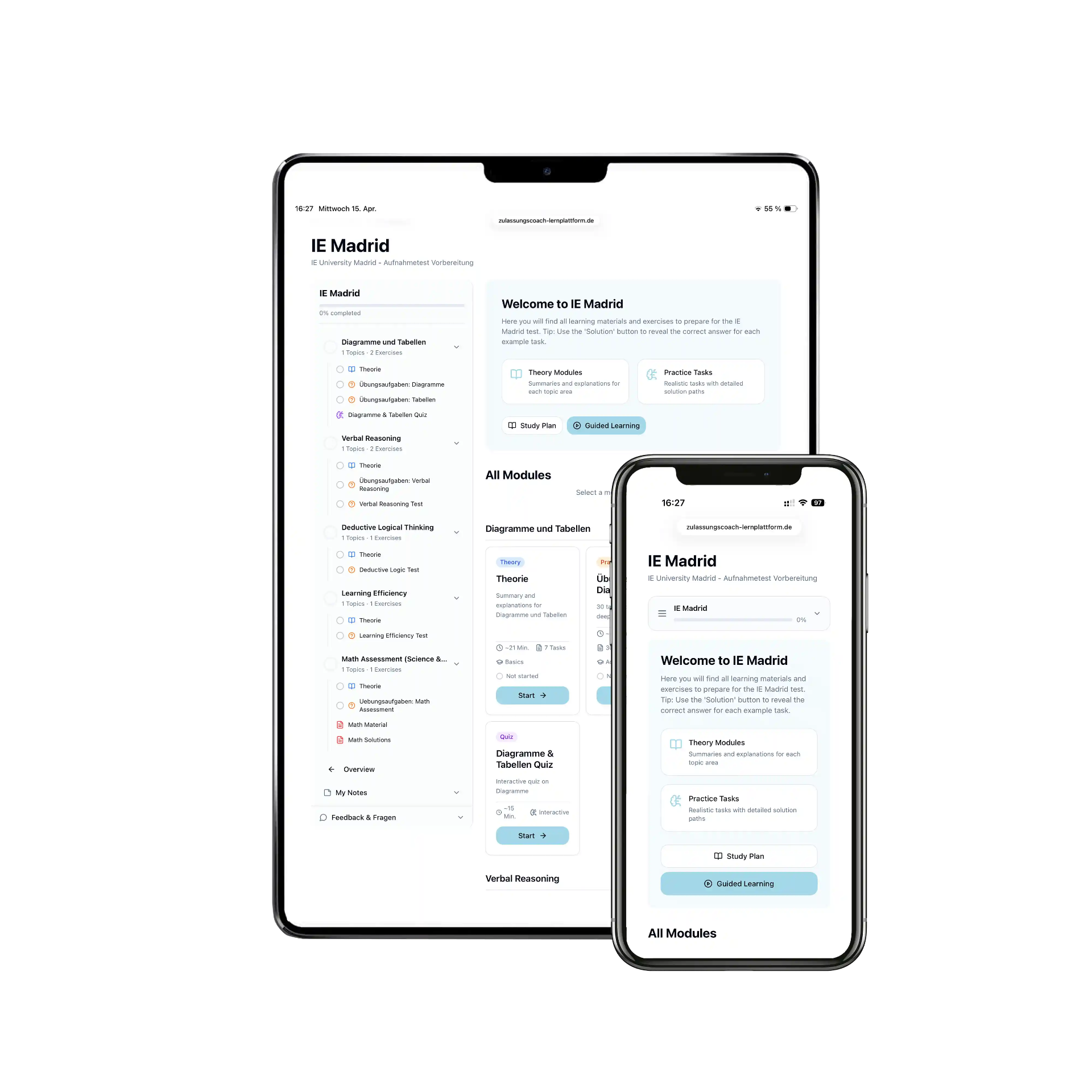
IE Madrid E-Learning
Prepare flexibly with structured lessons, exercises and practice material.
View offerIE Madrid 1-Day Seminar
Structured live preparation with direct guidance and room for questions.
View offerIE Madrid 2-Day Seminar
Structured live preparation with direct guidance and room for questions.
View offerZulassungscoach is an independent provider and is not affiliated with the institution or test provider named here.