
Applicants to specified IE School of Science and Technology bachelor programmes complete an additional 60-minute Mathematics Assessment within the admissions test. IE lists algebra, linear algebra, calculus, geometry, probability and statistics as the assessed knowledge areas. Applicants to other programmes should not assume that this extra section applies to them.
The decision behind the test
The current official list includes the Bachelor in Applied Mathematics, Computer Science and Artificial Intelligence, Data and Business Analytics, Environmental Sciences for Sustainability, and relevant dual degrees. Programme names can change, so the central admissions page and the chosen programme page should be checked together. The mathematics component differs from the reasoning sections because it explicitly assesses subject knowledge.
Current official position
IE publishes a dedicated mathematics assessment document and glossary support for mathematical vocabulary. The test is conducted in English. The extra 60 minutes must be considered when planning the session and technical setup. Alternative external tests may have programme-specific conditions, so applicants should confirm their route with admissions rather than generalizing from another degree.
Our recommended next steps
Map the official topic list to your current knowledge. Diagnose algebra and functions, geometry, calculus, linear algebra, probability and statistics separately. Review notation in English and practise solving without switching constantly between resources. Add mixed timed sets only after core methods are reliable. Use IE's official material to understand scope, not third-party claims about secret questions.
Mistakes we recommend avoiding
Some applicants train only numerical reasoning and overlook the separate knowledge-based mathematics section. Others assume advanced topics are identical across all external tests. Keep the IE topic list as the syllabus and verify calculator rules and interface requirements in the latest technical instructions.
What happens after the test?
The mathematics assessment forms part of the admissions evidence for the relevant programme. The committee also considers the rest of the application and online assessment. If admitted, applicants still need to satisfy final transcript, diploma and enrolment requirements.
Link every topic gap to a programme requirement
Confirm that the selected Science and Technology route actually includes the additional mathematics hour. Then give each published knowledge area a status: reliable, inconsistent or not yet reviewed. Attach one fresh problem set and one English terminology check to every weak row. This keeps preparation within IE’s stated scope and avoids spending time on advanced material simply because it appears in an unrelated external test.
Reserve a later 60-minute mixed rehearsal on the same device used for the general admissions assessment. Review setup, notation, domain restrictions and unit checks as well as final answers. The extra section changes the total concentration and technical window, so practise it as part of the full route rather than as an isolated school mathematics paper. Reconfirm calculator and interface rules shortly before testing instead of carrying assumptions from classroom examinations.
Archive the final topic inventory with the programme requirement so that a later admissions update can be checked against the exact route you prepared for.
Confirm whether the extra hour applies
The Mathematics Assessment is attached to specified School of Science and Technology bachelor routes, not to every IE undergraduate application. The current list includes Applied Mathematics, Computer Science and Artificial Intelligence, Data and Business Analytics, Environmental Sciences for Sustainability, and relevant dual degrees. Programme names and combinations can change, so compare the central test page with the page for the exact degree.
This check affects more than the syllabus. The additional section lasts 60 minutes, extending a session that already includes reasoning, instructions and examples. Reserve sufficient uninterrupted time and include the longer load in device, room and concentration planning. Applicants using an external test alternative should confirm programme-specific conditions with admissions rather than assuming equivalence.
Turn the official topic list into a diagnostic
Create six rows: algebra, linear algebra, calculus, geometry, probability and statistics. For each, solve a small fresh set and record whether the obstacle is concept recall, setup, notation, arithmetic or English terminology. This is more useful than assigning a single “maths level” to yourself.
Algebra work should cover manipulation, equations, inequalities, functions and relationships between representations. Linear algebra needs confident interpretation of vectors or matrices at the level shown by current official materials. Calculus preparation should connect derivatives or change to graphs and functions rather than rely on memorised operations alone. Geometry benefits from diagrams with constraints marked explicitly. Probability and statistics require careful distinction between counts, proportions, averages, spread and conditional information.
Use IE’s dedicated mathematics document as the boundary for scope. It helps identify knowledge demands; it is not a bank of live questions. Do not expand into advanced topics merely because a third-party course includes them. Depth and reliable execution on the stated foundations are more valuable than superficial coverage of unrelated material.
Learn to solve mathematics in English
The assessment is conducted in English. Build a glossary for terms that change the operation: intercept, slope, subset, mutually exclusive, independent, at most, variance, tangent and similar vocabulary found within the official scope. Pair each word with a short example rather than a translation alone.
When practising, restate the target in simple English, write the governing relation and only then calculate. This sequence separates a reading error from a mathematical one. Include units and domain restrictions. An algebraically valid result can still be impossible when the variable represents a probability, length or count.
Avoid switching constantly between several resources during one problem. That habit does not transfer to a timed assessment. Study a method, close the explanation and solve new tasks independently. Review afterwards, preserving the original steps so the point of failure remains visible.
Build timing after method reliability
Begin untimed in the weakest two topic rows. Once you can explain the method and reproduce it on unfamiliar questions, introduce short limits. Alternate topics so you must recognise the appropriate tool. Finish with mixed 60-minute blocks that resemble the sustained demand of the additional assessment without claiming to reproduce secure content.
Track “costly correct” answers as well as wrong ones. A solution that eventually succeeds after several false starts can consume time needed elsewhere. Write a cleaner route and identify the early signal that should have suggested it. Also practise estimation and answer checking; substituted values, units or boundary cases can reveal errors quickly.
Verify calculator and interface rules in the current technical instructions. Do not assume the tools permitted in school examinations apply. A rehearsal should use only allowed materials and the same computer setup planned for the IE test.
Integrate mathematics with the wider admissions file
The mathematics result is one part of the admissions evidence for relevant programmes. The general IE test still assesses numerical, verbal, deductive and learning-efficiency skills, and the application proceeds through an online assessment. Strong mathematics does not replace accurate documents, English communication or programme motivation.
Explain your interest in the chosen science or technology field through real learning and projects rather than through a predicted score. Keep school mathematics results and final-document requirements in view. An offer can remain conditional on completing the secondary qualification even after a successful assessment.
What happens next after the test?
The mathematics component is transmitted with the admissions-test evidence to IE’s committee; applicants do not normally receive a separate score report to upload. Complete the online assessment and watch for a possible interview or request for information. Do not plan a routine retake, because the IE undergraduate test is generally a one-attempt process.
If a technical issue affected the extra section, report the observable event promptly through the official channel. Avoid estimating a score from remembered questions. The university will determine how the incident is handled.
When a decision arrives, read all academic conditions. Admission may require final transcripts, diploma evidence, recognition or enrolment actions. The most useful post-test step is to keep those documents current and prepare for the communication stages, while letting the committee evaluate the assessment within the complete application.
Relevant preparation
Preparation for IE University
Choose the option that fits your next step. Scope and current pricing are shown on the offer page.
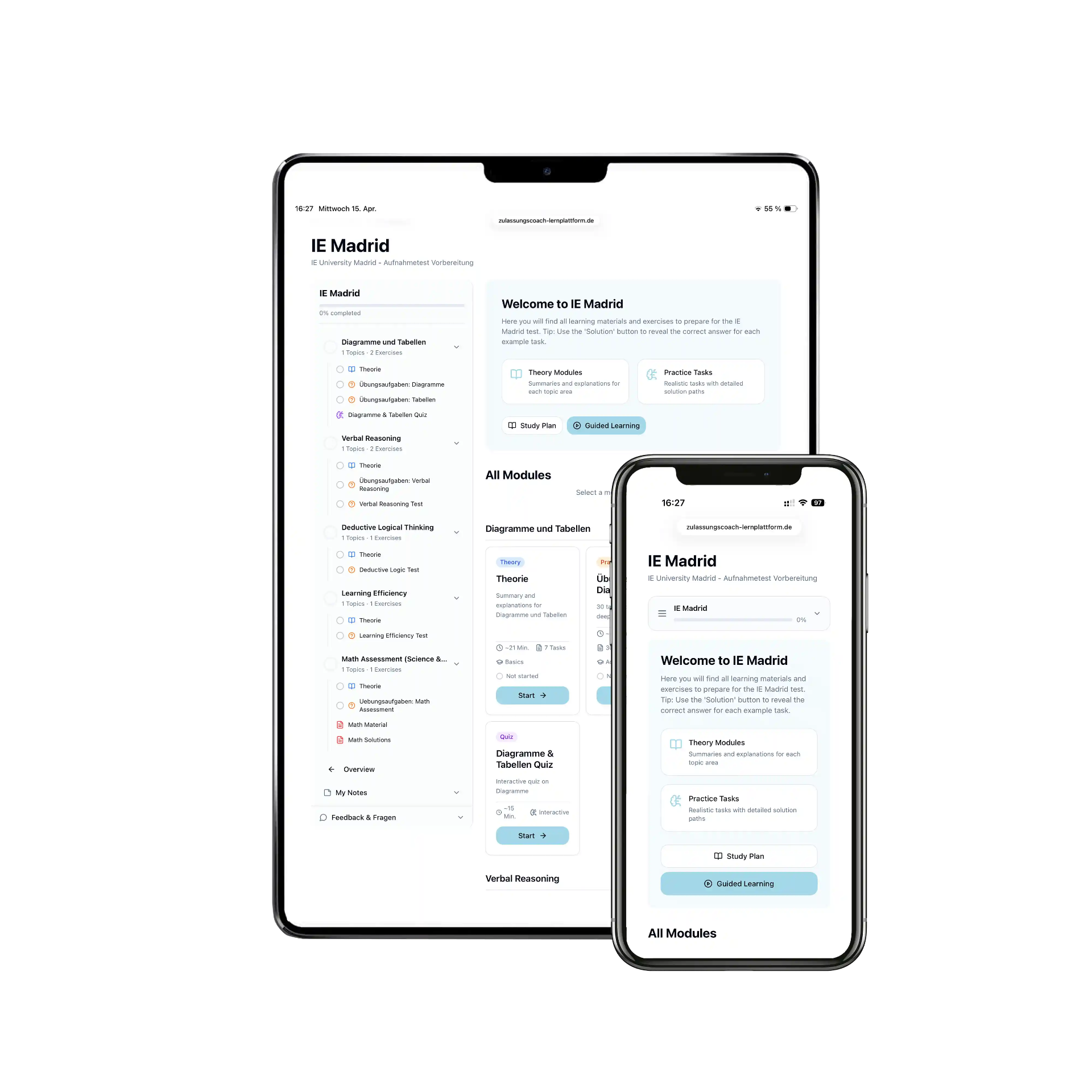
IE Madrid E-Learning
Prepare flexibly with structured lessons, exercises and practice material.
View offerIE Madrid 1-Day Seminar
Structured live preparation with direct guidance and room for questions.
View offerIE Madrid 2-Day Seminar
Structured live preparation with direct guidance and room for questions.
View offerZulassungscoach is an independent provider and is not affiliated with the institution or test provider named here.