
The IE Admissions Test is followed by an online assessment with short written and video responses. Some candidates may also be invited to a personal interview. An interview invitation or the absence of one is not described by IE as inherently positive or negative; it depends on what the committee needs to complete its review.
The decision behind the test
The online assessment is designed to show communication, critical thinking, personality and motivation beyond academic scores. A personal interview, when requested, gives the committee additional context about the applicant's aspirations and fit. These stages should be prepared for as communication tasks, not as another version of the reasoning test.
Current official position
IE describes the overall process as online application, admissions test, online assessment and personal interview where applicable, followed by the final committee decision. Freshman applications are assessed through a scoring system that considers academic records, extracurricular involvement, personal background, English proficiency, test results and online assessment performance.
Our recommended next steps
Review your submitted application before the online assessment. Prepare examples that explain choices, learning, collaboration and motivation without scripting full speeches. Practise concise answers on camera and check framing, audio and internet. For an interview, be ready to discuss the programme and your record accurately, including gaps or changes.
Mistakes we recommend avoiding
Treating the online assessment as a performance that rewards memorized slogans usually produces vague answers. Do not contradict documents already submitted or inflate achievements. Avoid assuming that a strong reasoning test makes the later stages unimportant.
What happens after the test?
The committee communicates its decision in writing. Admission is followed by official enrolment, final academic documents and any recognition, visa or relocation requirements. A conditional or early offer does not remove the obligation to submit final transcripts and complete registration.
Assemble evidence that remains consistent with the application
Reread the submitted form and choose examples that clarify its main claims. For each experience, note the situation, your action, the result and what changed in your thinking. Add one honest programme reason connected to your learning interests. This compact evidence bank can support different written, video or interview questions without turning answers into a memorised speech.
Practise the online assessment in the intended camera setup and review recordings for clarity, pace and specificity. If an interview is requested, prepare to explain academic changes or gaps with the same facts already supplied to IE. Keep logistical questions separately so they do not crowd out reflection practice. After each rehearsal, revise only the evidence or delivery habit that was unclear; repeatedly scripting whole responses tends to make them less responsive to the actual prompt.
Include one example that did not end perfectly. Explaining how you noticed a problem, adjusted your behaviour and carried the lesson forward often reveals more judgment than presenting only polished successes. Keep the account factual and proportionate to what actually happened.
Change preparation mode after the reasoning test
The next stage is not another set of numerical or logical items. IE’s online assessment uses short written and video responses to understand communication, critical thinking, personality and motivation. Preparation should therefore move from solving methods to personal evidence: what you chose, what you learned, how you worked with others and why the programme makes sense for your plans.
Begin by rereading the application you submitted. List the claims you made about interests, activities and goals. For each important claim, prepare one concrete example with context, action and outcome. Do not manufacture a dramatic story. A modest example explained clearly is more credible than an inflated achievement that conflicts with the file.
Build flexible evidence rather than scripts
Create a small evidence bank covering initiative, collaboration, disagreement, setback, curiosity and ethical judgement. The same experience may support different questions, but the emphasis should change. For a collaboration prompt, explain how others contributed; for a learning prompt, focus on what changed in your approach.
Practise answers with a simple shape: direct response, specific example, reflection. This is a guide, not a memorised speech. Fully scripted video answers often sound detached from the prompt and can collapse when wording changes. Aim for precise everyday language and a natural pace.
Written responses need quick planning. Identify the question, decide the central point and give each paragraph one job. Leave a brief check for missing words and contradictions. Video practice should include looking toward the camera, audible speech and a stable frame, but visual polish should not replace substance.
Prepare the technology without staging a performance
Use the computer and room intended for the online assessment. Test the camera, microphone, lighting and connection. Frame the shot so your face is clear and remove distractions. Wear something in which you can speak comfortably and professionally; there is no benefit in creating a theatrical setting that feels unlike you.
Record several practice responses and review them once for content and once for delivery. On the content pass, ask whether an outsider can understand the example and its relevance. On the delivery pass, check speed, filler words and eye line. Change one or two habits at a time. Endless rerecording can make answers rigid.
Keep application facts nearby for preparation but follow the live assessment rules on permitted materials. Do not read a hidden script. If an authentic technical issue occurs, record the observable details and use IE’s official support route.
When a personal interview is requested
Some applicants may be invited to an interview. IE does not describe an invitation—or the absence of one—as automatically positive or negative; the committee may need different information from different files. Treat the invitation as a request for context, not as a coded result.
Be ready to explain why the specific programme and IE environment fit your interests. Connect course or learning features to questions you have actually pursued. Review your academic history, including any gap, grade change or programme switch that may invite clarification. Answer honestly, state what you learned and avoid blaming others.
Prepare thoughtful questions whose answers are not obvious from the first admissions page. Questions can explore academic choices, projects or student support relevant to your decision. Their purpose is to clarify fit, not to demonstrate that you memorised marketing language.
During the conversation, listen to the complete question. It is acceptable to pause briefly before answering or ask for clarification. Concision helps the interviewer ask follow-ups. If you do not know something, acknowledge the limit and explain how you would find out rather than inventing an answer.
Keep the whole file coherent
IE describes undergraduate selection as holistic. Academic records, extracurricular involvement, personal background, English proficiency, test evidence and online-assessment performance contribute to review. The later stages should add dimension to the application rather than repeat its sentences.
Check dates, roles and outcomes against submitted documents. Consistency does not require robotic repetition; it requires that the facts agree. If circumstances changed after submission, explain the update clearly. Do not imply that a commercial coach or preparation provider is endorsed by IE; the university states that outside preparation centres are not officially affiliated.
What happens next after the test?
After the reasoning test, complete the online assessment when invited and monitor the application portal. If an interview request arrives, confirm the appointment and prepare the application-based evidence above. If no interview is requested, do not interpret that alone as an outcome.
The Admissions Committee sends its final decision in writing. On admission, read whether the offer is conditional and note acceptance, payment, final-transcript and enrolment deadlines. International applicants may need additional time for document recognition, visa or relocation procedures. Begin those tasks from official instructions once the offer is secure.
If the committee requests further information, answer the specific request rather than resubmitting the whole story. Keep copies of responses and confirmations. The transition after the test is successful when the reasoning result, online assessment, interview where applicable and documentary file all present one accurate account of the applicant.
Relevant preparation
Optional if you plan to retake the test
After the test, focus on your result and the next admissions step. This offer is only relevant if a retake is permitted and planned.
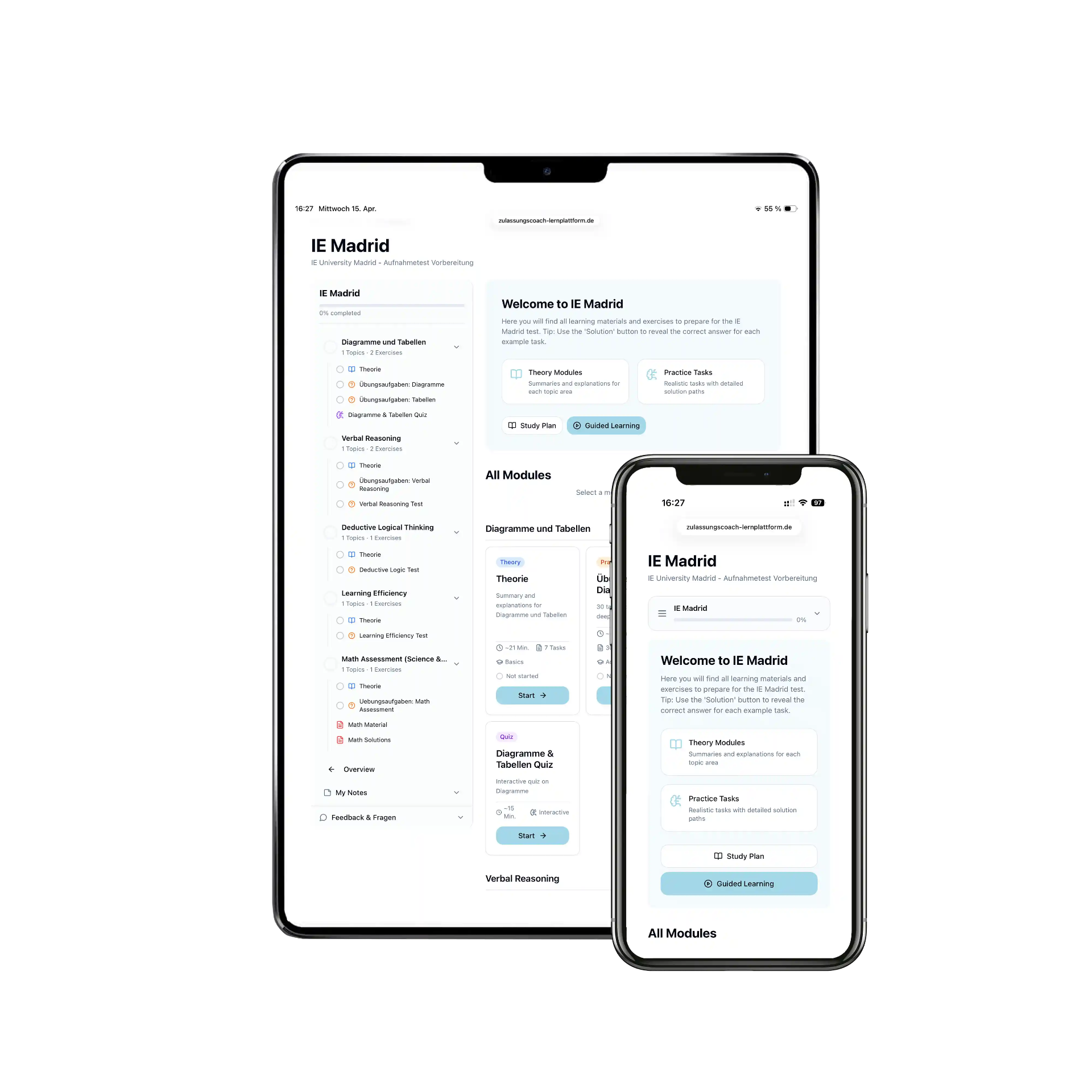
IE Madrid E-Learning
Prepare flexibly with structured lessons, exercises and practice material.
View offerIE Madrid 1-Day Seminar
Structured live preparation with direct guidance and room for questions.
View offerIE Madrid 2-Day Seminar
Structured live preparation with direct guidance and room for questions.
View offerZulassungscoach is an independent provider and is not affiliated with the institution or test provider named here.